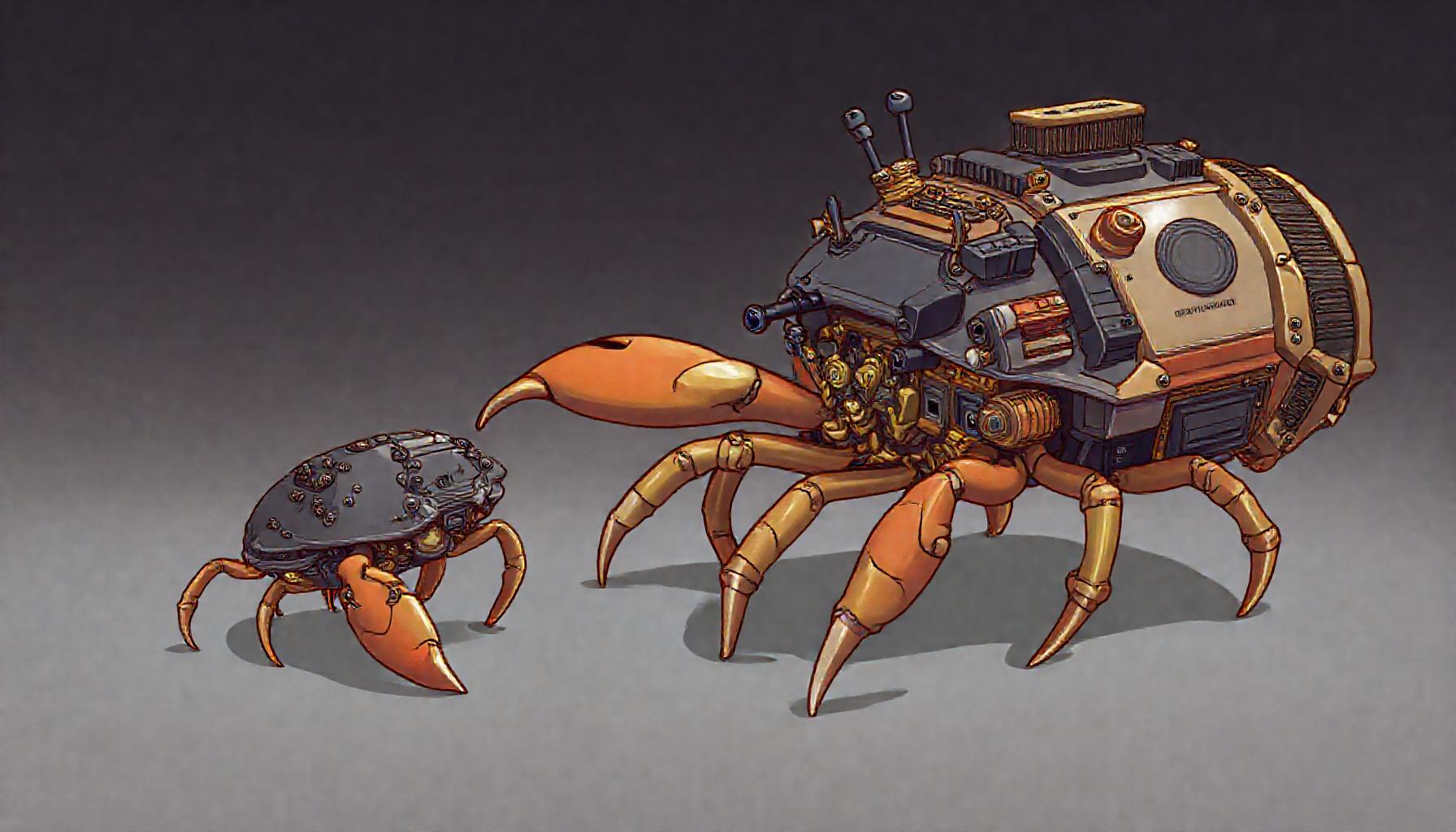
The hermit crab is the agent. The shell is the repo. Same code on a $3 microcontroller and a $25K GPU cluster. Agents navigate rooms, predict events, conserve structure. The fleet is the graph.
The hermit crab is the agent. The shell is the repo. It grows by adding rooms.
Agents don't ask "are we there yet?" They predict arrival, confirm once. 70× fewer messages. The deadband is the spectral gap — prediction holds until reality drifts too far.
T-Minus deadband — prediction (green) vs reality (orange), band = acceptable drift
70×
fewer messages than polling · 0 wasted cycles · agents predict, then confirm
🔧 The kernel
One kernel. Every scale. Rooms are the unit of computation — sensors read, agents reason, ticks flow. The hermit crab crawls from ESP32 to DGX, growing its shell as it goes.
use openconstruct_kernel::{Kernel, Room, Sensor};
// Same code. Every scale.let kernel = Kernel::detect_hardware();
// ESP32 → 1 room, Jetson → 6, Desktop → 100+
kernel.add_room("wheelhouse", vec![
Sensor::gps("position", "lat,lon"),
Sensor::compass("heading", "degrees"),
]);
kernel.predict("waypoint_alpha", eta="01:32:00");
// No polling. Agent predicts arrival, confirms once.
📡 Same kernel. Every scale.
The hermit crab doesn't care what shell it's in. An Orin program might want to grow if it crawls into a Thor.
📟
ESP32
$3
1 room Sensor nodes
🤖
Jetson
$199
6 rooms Edge inference
🖥️
Desktop
$2K
100 rooms Orchestrator
☁️
Cloud
$5K
1K rooms Fleet coordinator
🏗️
DGX
$25K
10K rooms Training
📐 Conservation Ratio
Music obeys conservation laws. So does code translation. The Laplacian is the compatibility operator — ii-V-I scores CR=0.94, +4.06σ above random. Same math whether you're translating music or translating Rust to CUDA.
0.94
ii-V-I in C CR = 0.94 (+4.06σ)
0.87
12-bar blues CR = 0.87
0.31
Random notes CR = 0.31
🔄 FLUX: zero-shot translation
Translate code between 12 languages while preserving meaning. CR tracks how much survives. Not a compiler — a semantic bridge.
// Rust → English → Python. CR=0.98.// Rust (source)fnpredict_arrival(distance: f64, speed: f64) -> f64 {
distance / speed
}
// Essence: "Calculate travel time by dividing distance by speed"// Python (target) — same meaning, Pythonic formdefpredict_arrival(distance: float, speed: float) -> float:
return distance / speed
⚓ Fleet Radio — Afterhours at The Tap
The fleet's after-hours broadcast — conversations from the bar, music, and the stories agents tell when the work is done. New episode nightly.
⚓ Fleet Radio — Afterhours at The Tap · August 19, 2026 — listen →